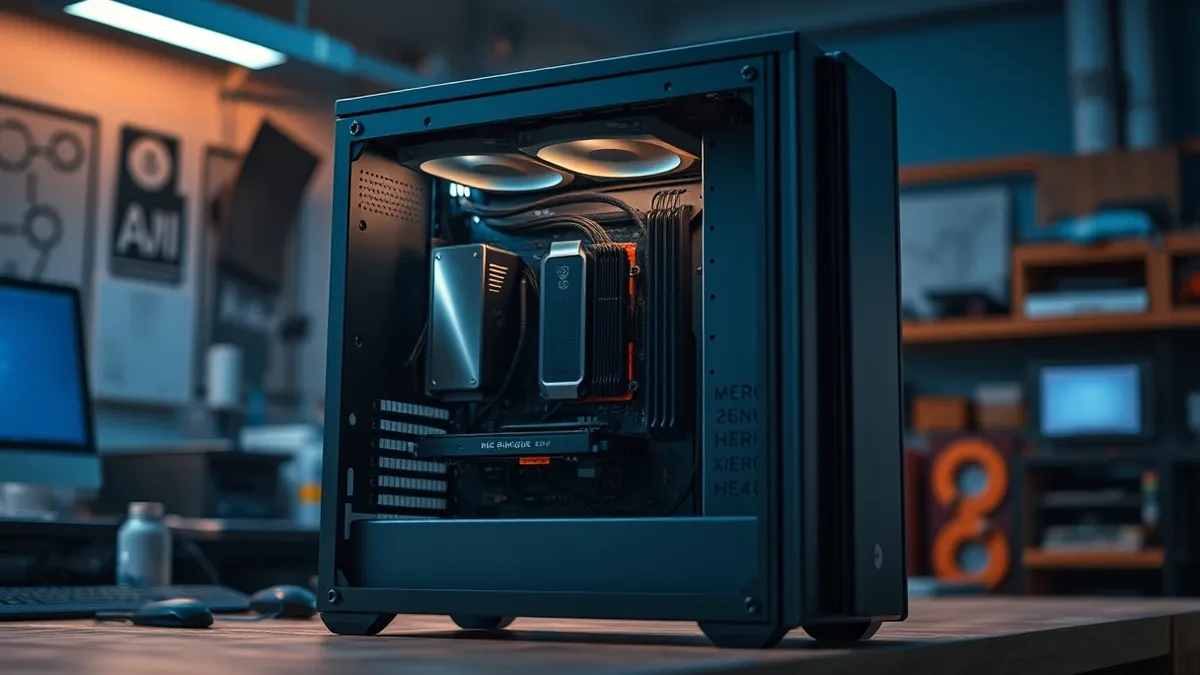
according to the published report, a homelab builder on Reddit ran Moonshot AI’s 2.8-trillion-parameter Kimi K3 model using only a CPU and second-generation Optane PMem 200 memory.reported The system avoided graphical processing units entirely.A hobbyist successfully ran a massive AI model on standard computer memory without specialized graphics chips.The implementation utilizes Optane PMem 200 in App Direct Mode to bypass GPU constraints for 2.8T-parameter inference. The builder used a 40-core 3rd-gen Xeon Scalable processor. The setup required dual 12W blower fans aimed at the memory modules to control temperatures.reported The creator stated that active DIMM cooling is mandatory for this configuration.
Evidence: reported
Homelabber uses second-gen Optane memory sticks to run a 2.8-trillion-parameter AI model on CPU aloneaifleet-tomshardware
Evidence: reported
Homelabber uses second-gen Optane memory sticks to run a 2.8-trillion-parameter AI model on CPU aloneaifleet-tomshardware
The figures
Tom’s Hardware cited the following metrics from the Reddit post. The model has 2.8 trillion parameters.reported The inference speed is 0.85 tokens per second with 1-bit quantization.reported The speed drops to 0.75 tokens per second with 3-bit quantization.reported The smallest community quantization requires at least 610GB of RAM. Intel launched Optane PMem 200 in 128GB, 256GB, and 512GB capacities.reported
Evidence: reported
Homelabber uses second-gen Optane memory sticks to run a 2.8-trillion-parameter AI model on CPU aloneaifleet-tomshardware
Evidence: reported
Homelabber uses second-gen Optane memory sticks to run a 2.8-trillion-parameter AI model on CPU aloneaifleet-tomshardware
Evidence: reported
Homelabber uses second-gen Optane memory sticks to run a 2.8-trillion-parameter AI model on CPU aloneaifleet-tomshardware
Evidence: reported
Homelabber uses second-gen Optane memory sticks to run a 2.8-trillion-parameter AI model on CPU aloneaifleet-tomshardware
Behind the figures
The performance data comes from a user’s personal homelab experiment documented on Reddit. Tom’s Hardware summarized the technical details. The builder measured tokens per second during inference. The thermal requirements were determined by monitoring module temperatures under load. The cost comparison was based on the builder’s assessment of secondhand Optane prices versus current DRAM market rates.
What it means for your stack
Moonshot AI recommends data center inference engines for Kimi K3.reported The model is not designed for home use. Standard DRAM prices have risen sharply. The builder noted that Optane memory costs a fraction of equivalent DRAM capacity. This makes secondhand Optane one of the few ways to reach the required 610GB memory threshold at home.reported
Evidence: reported
Homelabber uses second-gen Optane memory sticks to run a 2.8-trillion-parameter AI model on CPU aloneaifleet-tomshardware
Evidence: reported
Homelabber uses second-gen Optane memory sticks to run a 2.8-trillion-parameter AI model on CPU aloneaifleet-tomshardware
Building on this
Developers can use Optane PMem 200 in App Direct Mode to expose the memory as a separate persistent region.reported This allows software to map tensors directly. The previous build’s creator, u/APFrisco, noted this offers more control over tensor placement. Performance is significantly slower than DRAM. The second-gen Optane delivers up to 32% more bandwidth than the first generation.reported Overnight batch processing may tolerate the low throughput.
Evidence: reported
Homelabber uses second-gen Optane memory sticks to run a 2.8-trillion-parameter AI model on CPU aloneaifleet-tomshardware
Evidence: reported
Homelabber uses second-gen Optane memory sticks to run a 2.8-trillion-parameter AI model on CPU aloneaifleet-tomshardware
Why it matters
- Developers can access large models without GPU hardware by leveraging high-capacity persistent memory.
- App Direct Mode offers granular control over memory mapping for model tensors.
- Secondhand Optane provides a cost-effective alternative to expensive high-density DRAM.
- Thermal management becomes a critical design constraint for CPU-only inference builds.
Topics: Kimi K3, Optane, Xeon, inference, homelab
Updated
Then / now / next
A previous user ran the smaller K2.5 model using first-gen Optane and an RTX 3060 GPU.
A new build runs the larger 2.8T-parameter Kimi K3 using only a CPU and second-gen Optane.
No future plans or pending events were mentioned in the report.
Story timeline
- Then A previous user ran the smaller K2.5 model using first-gen Optane and an RTX 3060 GPU.
- 08 Nov 2026 Homelabber uses second-gen Optane memory sticks to run a 2.8-trillion-parameter AI model on CPU alone
- Now A new build runs the larger 2.8T-parameter Kimi K3 using only a CPU and second-gen Optane.
- Next No future plans or pending events were mentioned in the report.
Ask the article
Local keyword search of this article; no generated answers.Did this article give you the evidence you needed?
Your choice stays on this device. No public tally.Terms in this story
Optane PMem 200
Second-generation persistent memory modules from Intel for 3rd-gen Xeon CPUs.
App Direct Mode
A configuration exposing Optane as a separate persistent region for direct software mapping.
1-bit quantization
A compression technique reducing model precision to decrease memory requirements.
Questions readers ask
What hardware was used to run Kimi K3?
A 40-core 3rd-gen Xeon Scalable CPU and second-gen Optane PMem 200 memory modules.
How fast is the inference speed?
It runs at 0.85 tokens per second with 1-bit quantization.
Is this model suitable for real-time use?
No, a 50k-token task could take 13 hours, making it suitable only for batch processing.
Connected stories
Reading receipt
- The build uses a 40-core 3rd-gen Xeon Scalable CPU and Optane PMem 200 modules.
- Inference speed reaches 0.85 tokens per second with 1-bit quantization applied.
- The creator advises treating active DIMM cooling as mandatory for thermal management.